Fiber internet is a modern broadband technology that delivers data using pulses of light transmitted through thin strands of glass or plastic known as fiber-optic cables. Unlike older internet technologies that rely on electrical signals traveling over copper wiring, fiber internet uses light to transmit information at extremely high speeds over long distances with minimal signal loss. Because of its speed, reliability, and scalability, fiber has become the preferred internet delivery method for homes, businesses, schools, hospitals, and data centers.
For the CompTIA A+ technician, fiber internet represents the foundational connection between the customer environment and the wider internet. While A+ technicians are not typically responsible for installing fiber cables in the ground, they must understand how fiber internet works, how it connects to local networks, and how to troubleshoot common fiber-related connectivity issues at the device and customer-premises level.
What Fiber Internet Is
Fiber internet is an internet service delivered over fiber-optic cabling, which transmits data as light rather than electricity. Data is encoded into light pulses that travel through a glass or plastic core surrounded by reflective cladding, allowing the light to bounce internally along the cable with minimal loss. This method enables extremely fast data transmission and supports much higher bandwidth than traditional copper-based technologies.
Fiber internet is typically provided directly by an Internet Service Provider (ISP) and terminates at the customer’s location using specialized equipment that converts optical signals into standard Ethernet signals that local network devices can understand.
Why Fiber Internet Exists
Earlier internet technologies such as dial-up, DSL, and cable were designed when internet usage was limited to basic tasks like email and web browsing. As modern computing evolved to include cloud services, video streaming, video conferencing, online gaming, remote work, and large data transfers, older technologies became bottlenecks.
Fiber internet exists to solve several critical problems:
- Copper wiring has physical speed limitations due to electrical resistance and interference
- Signal quality over copper degrades significantly over long distances
- Older technologies struggle with upload speeds and latency
- Modern applications require symmetrical, high-bandwidth connections
Fiber solves these issues by using light, which can travel faster, farther, and with far less interference than electrical signals. This makes fiber ideal for current and future internet demands.
Purpose of Fiber Connectors
The primary purpose of a fiber connector is to join two fiber-optic cables or connect a fiber-optic cable to a device without permanently splicing the cable. Connectors allow for modular installation, easier troubleshooting, and equipment replacement without re-running fiber.
Because fiber transmits data as light, connectors must ensure:
- Accurate core-to-core alignment
- Minimal signal loss (attenuation)
- Minimal light reflection (back reflection)
These requirements make fiber connectors more sensitive than copper connectors and more vulnerable to contamination and physical damage.
Common Fiber Connector Types
Several fiber connector types exist, but the CompTIA A+ exam focuses on recognition and general usage rather than installation procedures.
ST (Straight Tip) connectors use a bayonet-style twist-lock mechanism. They were common in older multimode fiber installations and are still occasionally found in legacy environments. ST connectors are typically cylindrical and require a push-and-twist motion to lock into place.
SC (Subscriber Connector or Square Connector) connectors use a square, push-pull design that allows for quick insertion and removal. SC connectors are common in enterprise networking equipment and ISP environments, particularly for fiber internet service connections.
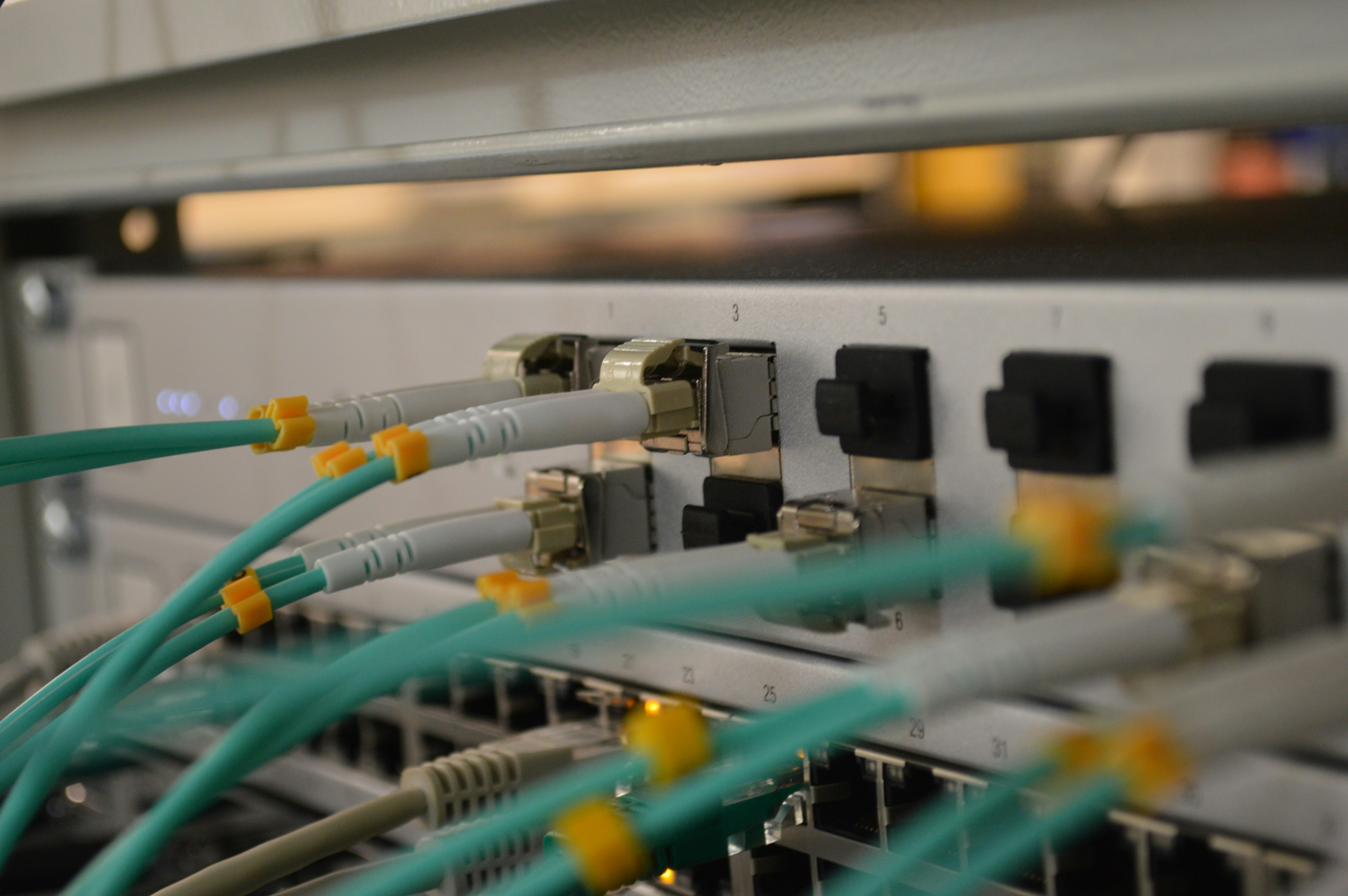
LC (Lucent Connector) connectors are smaller than SC connectors and use a similar push-pull locking mechanism. Their compact size allows for higher port density on networking equipment, making them common in modern switches, SFP modules, and high-density patch panels.
FC (Ferrule Connector) connectors use a threaded screw-on design to provide a secure connection.