A computer power supply does not create electricity by itself. It receives electricity from the wall outlet and converts it into the lower-voltage DC power that computer parts need. Before that conversion can happen, the power supply must accept the correct input voltage from the electrical outlet.
For CompTIA A+ Core 1, students should understand the difference between 110–120 VAC and 220–240 VAC because power supplies are designed to receive power from different electrical systems. This topic appears in the power supply objective for installing the appropriate power supply.
What Does VAC Mean?
VAC stands for volts alternating current.
Wall outlets provide alternating current, or AC. This means the electrical current changes direction many times per second. Computers, however, do not use AC power directly inside the case. Internal components need direct current, or DC.
The power supply unit, often called the PSU, converts wall outlet AC power into DC power used by the motherboard, CPU, RAM, storage drives, fans, and expansion cards.
When you see 110–120 VAC or 220–240 VAC, that describes the type of AC input power the power supply expects from the wall.
110–120 VAC
In some regions, standard wall outlets provide around 110–120 volts AC. This is commonly associated with household and office electrical outlets in places such as the United States and Canada.
A desktop computer plugged into this type of outlet receives power in the 110–120 VAC range. The power supply then converts that input into the DC voltages needed by the computer, such as 3.3V, 5V, and 12V.
For a technician, the important idea is that the power supply must be able to accept this input voltage safely. If a power supply is set for the wrong input voltage, the computer may fail to power on or the power supply may be damaged.
220–240 VAC
In other regions, standard wall outlets provide around 220–240 volts AC. This is common in many parts of Europe, Asia, Africa, and other areas around the world.
A computer power supply used in one of these regions must support 220–240 VAC input. Many modern power supplies are designed to support a wide input range, but older or cheaper units may require manual selection.
The key point is that 220–240 VAC is a higher input voltage than 110–120 VAC. The power supply must be designed or configured to handle it.
Why Different Countries Use Different Voltages
Electrical systems developed differently around the world. Because of this, not every country uses the same household outlet voltage or plug type.
This matters for IT support because computers, monitors, printers, and other devices may be moved between regions. A desktop computer that worked in one country may not be safe to plug in directly in another country unless the power supply supports the local voltage.
Technicians should not assume that every outlet provides the same voltage. They should check the device label, power supply label, or manufacturer documentation before connecting equipment in a new location.
Manual Voltage Selector Switches
Some older power supplies have a small red or recessed switch on the back labeled something like 115V and 230V. This is a manual voltage selector.
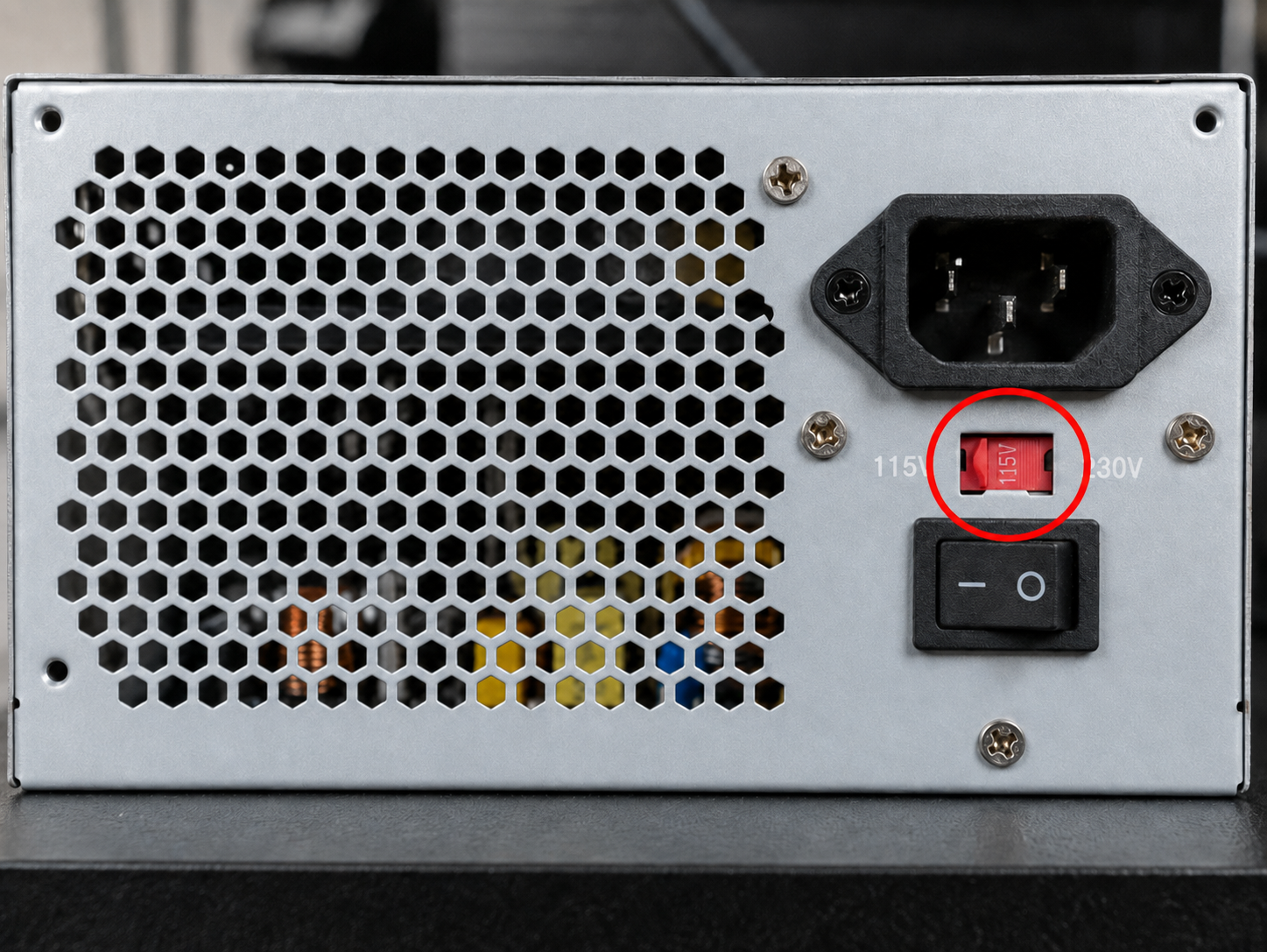
If the computer is being used with a 110–120 VAC outlet, the switch should be set to the 115V position. If the computer is being used with a 220–240 VAC outlet, the switch should be set to the 230V position.
This switch is very important. If it is set incorrectly, serious problems can happen.
For example, if a power supply is set to 115V and plugged into a 230V outlet, the power supply may be overloaded and damaged. It may pop, smoke, blow a fuse, or fail completely.
If a power supply is set to 230V and plugged into a 120V outlet, the computer may not power on correctly because the power supply is expecting a higher input voltage than it receives.
Auto-Switching Power Supplies
Many modern power supplies are auto-switching. This means they can automatically detect and accept a wide range of input voltages, often something like 100–240 VAC.
An auto-switching power supply does not need the user to manually flip a 115V/230V switch. It adjusts internally to the input power provided by the outlet.
This is common on many modern desktop power supplies, laptop chargers, monitors, and other electronics.