Radio-Frequency Identification, commonly known as RFID, is a wireless technology that uses radio waves to automatically identify and track objects, animals, or people. Unlike barcodes, which require direct line-of-sight scanning, RFID can read tags through packaging, clothing, and other materials without requiring precise alignment. This capability has made RFID essential for inventory management, access control, asset tracking, and countless other applications.
RFID predates many modern wireless technologies, with roots going back to World War II when similar principles were used to identify friendly aircraft. The technology has evolved significantly since then, becoming smaller, cheaper, and more capable. For the CompTIA A+ 1201 exam, you need to understand how RFID works, the different types of RFID systems, and common applications you may encounter in IT environments.
How RFID Works
Basic Components
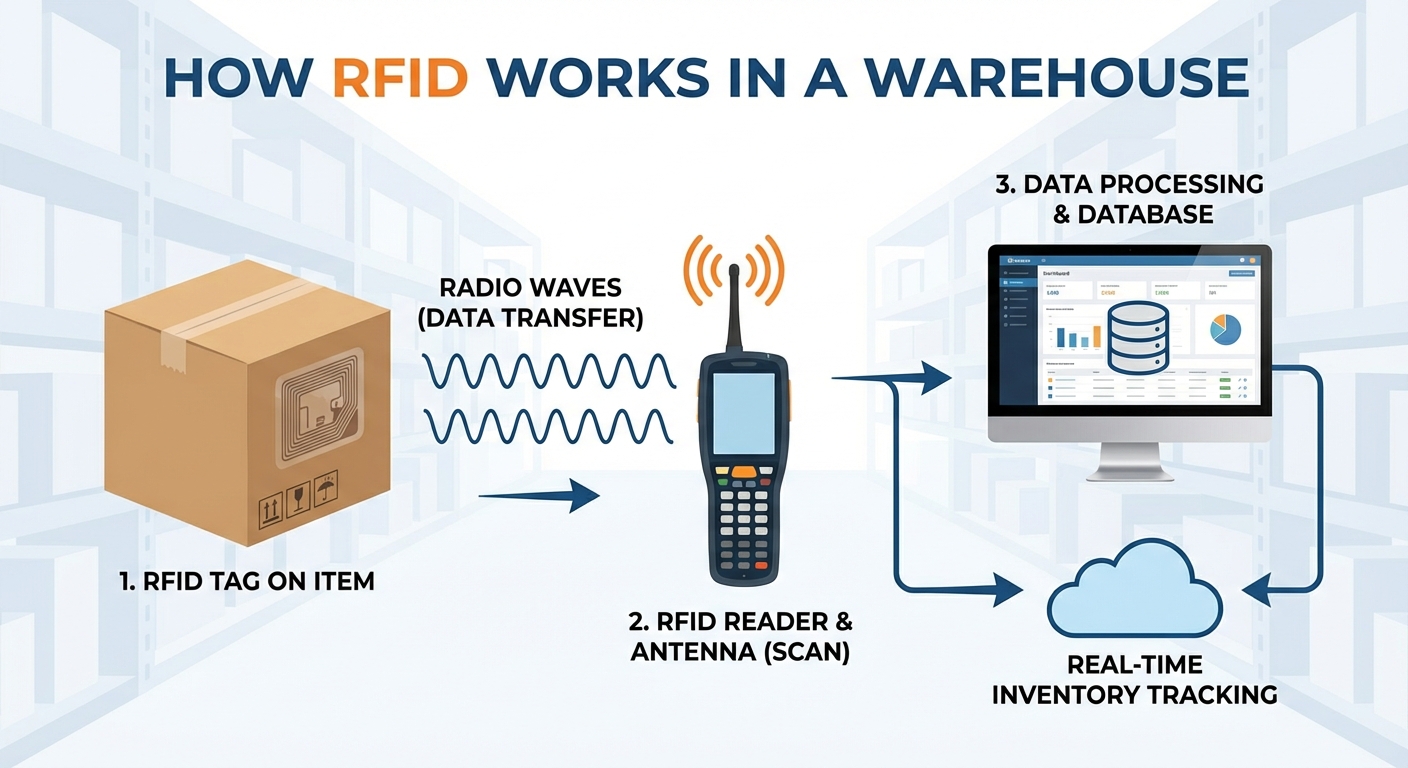
Every RFID system consists of three fundamental components that work together to identify and track tagged items.
The RFID tag, also called a transponder, is attached to the object being tracked. Each tag contains a microchip that stores identifying information and an antenna that enables wireless communication. Tags can be as small as a grain of rice or as large as a paperback book, depending on the application and required read range.
The RFID reader, also called an interrogator, generates radio waves and receives signals back from tags. Readers can be handheld devices resembling barcode scanners, fixed units mounted at doorways or conveyor belts, or integrated into other equipment. The reader converts the radio signals from tags into digital data that can be processed by computer systems.
The backend system processes the data collected by readers. This typically includes software that interprets tag data, databases that store information about tagged items, and integration with other business systems like inventory management or access control platforms.
The Communication Process
RFID communication follows a straightforward sequence. The reader continuously or periodically broadcasts radio waves through its antenna, creating an electromagnetic field in the surrounding area. When a tag enters this field, it detects the radio waves and responds by transmitting its stored data back to the reader. The reader captures this response and forwards the information to the backend system for processing.
The specific details of this process vary depending on whether the tag is active, passive, or semi-passive, which determines how the tag obtains the power needed to transmit its response.
Operating Frequencies
RFID systems operate across several frequency bands, each with distinct characteristics suited to different applications.
Low Frequency RFID operates between 125 and 134 kHz. These systems have short read ranges, typically less than 10 centimeters, and slow data transfer rates. However, low frequency signals penetrate water and body tissue well, making this band ideal for animal identification and implantable chips. The signals also work reliably around metal and liquids that can interfere with higher frequencies.
High Frequency RFID operates at 13.56 MHz, the same frequency used by NFC. Read ranges extend to about one meter under optimal conditions, with moderate data transfer rates. This frequency band is widely used for access control cards, library books, and contactless payment cards. High frequency systems offer a good balance between read range, cost, and reliability.
Ultra-High Frequency RFID operates between 860 and 960 MHz, with the exact frequencies varying by region due to different regulatory allocations. UHF systems offer much longer read ranges, potentially exceeding 12 meters with active tags, and faster data transfer rates. This makes UHF ideal for supply chain applications, inventory management, and situations requiring bulk reading of many tags simultaneously. However, UHF signals do not penetrate water or metal well and can experience interference in complex environments.
Microwave RFID operates at 2.45 GHz and 5.8 GHz. These systems offer the longest potential read ranges and fastest data rates but are most susceptible to environmental interference. Microwave RFID is less common than other frequencies and typically used in specialized applications like vehicle toll collection.
Types of RFID Tags
Passive Tags
Passive RFID tags contain no battery and instead harvest energy from the radio waves transmitted by the reader. When the reader's electromagnetic field reaches the tag, it induces a small electrical current in the tag's antenna. This current powers the microchip just long enough to transmit the tag's stored data back to the reader.
The lack of a battery gives passive tags significant advantages. They are inexpensive to manufacture, often costing only a few cents each in large quantities. They have an essentially unlimited operational lifespan since there is no battery to deplete. They can be made extremely small and thin, allowing embedding in labels, cards, or products.
However, passive tags have limitations. Read range is restricted because the tag must be close enough to harvest sufficient energy from the reader's field. Typical read ranges for passive tags vary from a few centimeters for low frequency systems to several meters for UHF systems. The tags cannot initiate communication and can only respond when queried by a reader.
Passive tags are by far the most commonly deployed type, used in applications ranging from retail inventory to building access cards to library books.
Active Tags
Active RFID tags contain their own battery, which powers the microchip and enables the tag to broadcast signals independently. This self-powered operation provides several capabilities that passive tags cannot match.
Active tags achieve much greater read ranges, potentially exceeding 100 meters depending on the frequency and environment. They can transmit stronger signals that penetrate obstacles more effectively. They can also initiate communication rather than waiting to be queried, enabling real-time tracking applications. Some active tags include sensors that monitor temperature, humidity, motion, or other environmental conditions, transmitting this data along with their identification.
The disadvantages of active tags relate primarily to the battery. Active tags cost significantly more than passive tags, typically several dollars to tens of dollars each.